What this means for a 4-bed home: since March 1, 2026, QIP is the only path to the last 10% of your rate — there is no more "hold harmless" cushion. On a $15,000/month rate model per resident, missing QIP costs roughly $1,500 per resident per month, or about $72,000 a year for a four-bed home. And you have to re-qualify every single cycle; earning it once does not earn it forever.
What QIP actually is
QIP stands for Quality Incentive Program — not "Quality Improvement Plan," a different term entirely that belongs to Community Care Licensing's deficiency/plan-of-correction process, not to DDS. QIP is run by the California Department of Developmental Services, under Welfare & Institutions Code §4519.10, enacted through the 2021 budget trailer bill AB 136 as part of developmental-services rate reform. DDS announced it by letter on September 23, 2022.
This guide is the deep-dive companion to our QIP Compliance Guide, which covers the program at a glance.
Why it matters: this is the whole 10%
Under rate reform, every rate-reform rate has two components: a base rate equal to 90% of the posted rate model, and a quality incentive payment of up to 10% more, earned only through QIP participation. Providers whose July 1, 2024 rates already exceeded 90% of the rate model were temporarily "held harmless" — but per DDS Directive D-2025-Rate Reform-006 (July 2, 2025), that cushion was accelerated to end February 28, 2026. Effective March 1, 2026, providers who earned the quality incentive moved to 100% of the posted rate model; providers who didn't stayed at 90%.
This applies to service codes 905 and 915 (Residential Facility Serving Adults, owner- and staff-operated), 910 and 920 (Residential Facility Serving Children, owner- and staff-operated), 113 (Specialized Residential Facility / ARFPSHN), and 904 (Family Home Agency). If you're not sure which of these is you — or whether you're on a rate-component code at all versus a one-time-incentive code — see our companion guide, Which Service Code Are You?
The four gates: what actually earns the 10%
For a typical 4-6 bed home, four things determine whether you see any of that 10% — two are procedural gates you have to keep current, and two are the actual reporting measures that carry the money. Clear all four and you're positioned for the full 10%; miss one reporting measure and you lose exactly that half.
Provider Directory registration & validation
You must be registered and validated in the DDS Provider Directory to be included in QIP data collection at all — miss this and you never even receive the surveys. For the FY 2026-27 cycle, existing providers had to be validated by October 30, 2025 (D-2025-QIP-015, October 9, 2025). Survey links go only to the administrative email address on file, so a stale email is the same as never registering.
What this means for a 4-bed home: the day your administrator changes, your Provider Directory email is a compliance task, not an afterthought — check it any time your front-office contact changes, not just once a year.
EVV registration or a regional-center-confirmed exemption
Complete Electronic Visit Verification self-registration, or get your regional center to confirm an exemption. For the FY 2026-27 cycle, registration or a good-faith effort was enough to clear this gate — but D-2026-QIP-001 states that "actual implementation" of EVV will be required in future fiscal years for providers to whom EVV capture applies. Many small residential settings are exempt from EVV data capture itself, but the QIP gate is about your registration/exemption status being resolved, not about capturing every visit.
What this means for a 4-bed home: "we're exempt" isn't the same as "we're done" — you still need the exemption confirmed and on file with your regional center, and you should expect the bar to rise in a future cycle.
The Prevention & Wellness survey
For each resident who lived in the home at least one month during the reporting fiscal year, you report the date they last received each applicable preventive screening (D-2025-QIP-017REV). DDS pre-populates your resident list; you supply the dates. For the current reporting-only cycle, you earn this 5% by reporting completely and accurately, not by hitting a performance target — those come later.
Adults (905/915): physical exam and dental exam at least once in the fiscal year; colorectal cancer screening for ages 45-75 (stool test within the year, sigmoidoscopy within 5 years, or colonoscopy within 10 years); mammography for women 50-74 every 2 fiscal years; cervical cancer screening for women 21-65 every 3 fiscal years.
Children (910/920): annual wellness visit, dental exam twice per fiscal year, vision exam per periodicity schedule, and immunizations up to date.
What this means for a 4-bed home: your resident health file needs dates, not "done" checkboxes, and lookback windows run as long as 10 fiscal years for colonoscopies. Book screening appointments in Q1-Q3 of the fiscal year — a resident who can't get a dental slot before June 30 is a gap you cannot fix retroactively.
The Provider Capacity report
Organization-level reporting (D-2025-QIP-018REV): service zip codes and languages spoken, ownership structure, full- and part-time staff counts at the start and end of the reporting fiscal year, staff tenure, average starting and hourly wage for non-managerial direct-care staff, and vacancies and separations.
What this means for a 4-bed home: you need payroll/HR records that can answer "how many DSPs did we employ on July 1 versus June 30, what did we pay them, and how many left" — and starting with the FY 2027-28 cycle, this reports per vendor number, so organize records by vendor number now if you run more than one home.
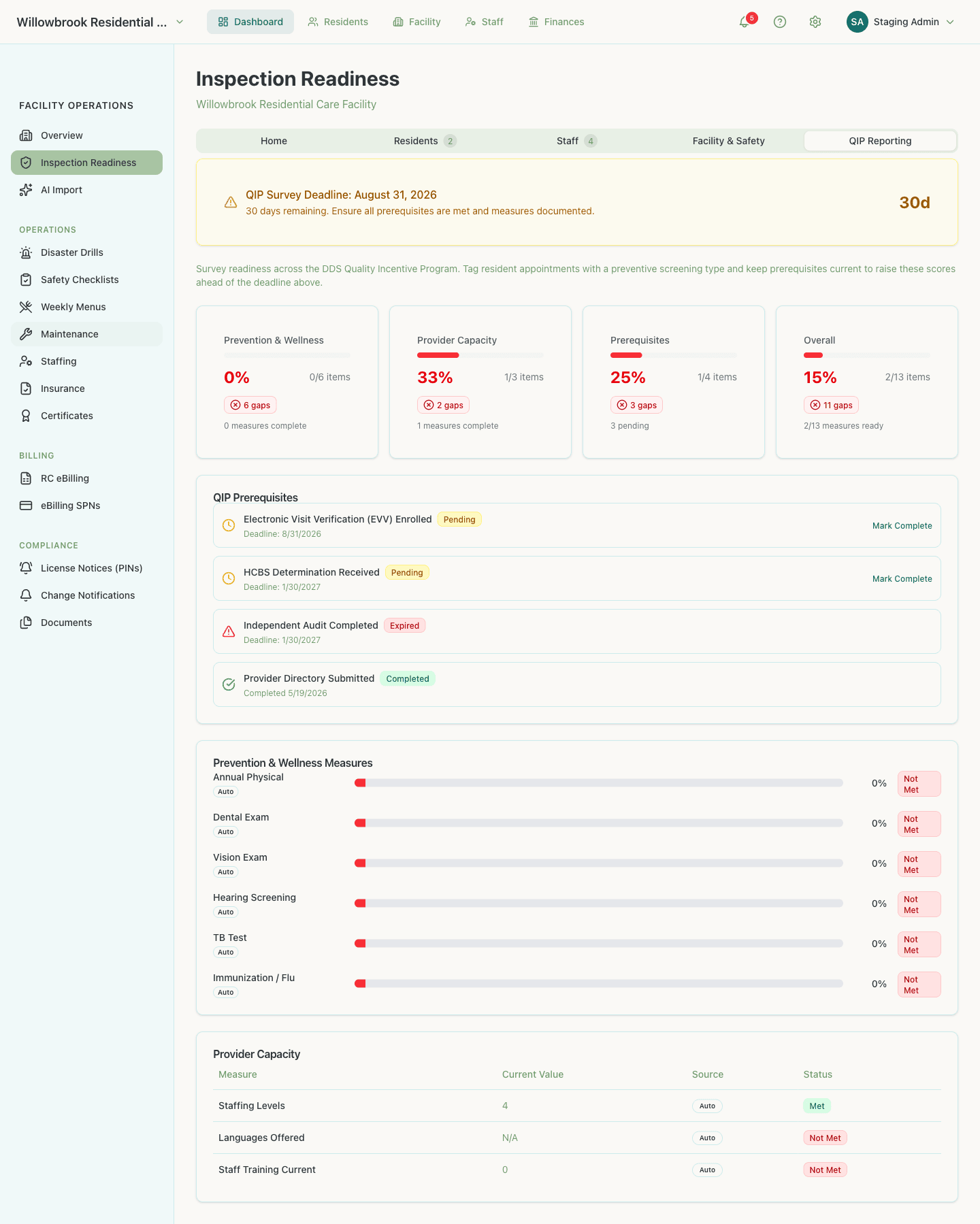
All four, tracked on one screen
You don't have to track these four gates across four inboxes and a spreadsheet. Here's what it looks like when they live in one place.
Two more things that can quietly block your 10% anyway
The four gates above are the ones nearly every 4-6 bed home has to actively manage. Two more eligibility requirements sit underneath them — worth knowing even though one is usually determined by your regional center and the other often doesn't apply at your size:
HCBS Settings Final Rule compliance
Your vendoring regional center determines your compliance under the January 8, 2024 DDS directive. DDS stated that as of July 2025 all service providers had been determined compliant — but compliance is ongoing: the federal Medicaid Access Rule gives individuals a grievance right for alleged HCBS noncompliance after July 9, 2026, which raises the stakes of maintaining compliant day-to-day practices (community access, resident rights, lease-like protections, choice, privacy) rather than treating the determination as a one-time event.
Independent audit or review (WIC §4652.5)
| Regional-center revenue in the state fiscal year | Requirement |
|---|---|
| $2,000,000 or more | Independent audit |
| $500,000 up to $2,000,000 | Independent review |
| Under $500,000 | Not required — confirm your exemption with your regional center |
Due to your regional center within 9 months of your provider fiscal-year end, unless a written exemption has been granted.
What this means for a 4-bed home: a single small home's regional-center revenue is often under the $500,000 floor, which usually means no audit or review is required — but "often" isn't "always," especially if you run more than one home under the same vendor number. Confirm your tier directly with your regional center rather than assuming; being behind on this, or unresponsive to findings, blocks the incentive just like missing a gate does.
For the full breakdown — exact thresholds, why the deadline isn't a fixed calendar date, what engaging a CPA looks like, and the exemption many small homes qualify for — see our deep-dive, Independent Audit vs. Review →
Key dates, published vs. projected
Every date below cites the directive that set it. Dates marked Projected are our estimate based on last cycle's pattern — not yet confirmed by DDS. For the complete, continuously updated timeline (including whatever DDS publishes next), see the QIP Dateline →
| Date | What | Status | Directive |
|---|---|---|---|
| Oct 9, 2025 | FY 2026-27 measure & eligibility directives issued | Published | D-2025-QIP-015/016/017/018 |
| Oct 30, 2025 | Provider Directory validation cutoff (existing providers) | Published | D-2025-QIP-015 |
| Nov 3, 2025 | Qualtrics survey links began going out | Published | QIP program records |
| Feb 27, 2026 | Extended deadline to submit all surveys and meet eligibility (originally Jan 31) | Published | DDS extension, Jan 12, 2026 |
| Feb 28 / Mar 1, 2026 | Hold harmless ended; rates adjusted to 100% (earners) or 90% | Published | D-2025-Rate Reform-006 |
| Apr 2026 | Final FY 2026-27 provider compliance lists posted | Published | Provider QIP Incentive Status |
| ~Oct 2026 | FY 2027-28 measure & eligibility directives (last cycle: Oct 9) | Projected | Pattern from FY 2026-27 |
| ~Nov 2026 | FY 2027-28 survey links go out (last cycle: Nov 3) | Projected | Pattern from FY 2026-27 |
| ~Jan-Feb 2027 | FY 2027-28 survey + eligibility deadline (last cycle: Jan 31, extended to Feb 27) | Projected | Pattern from FY 2026-27 — do not plan around an extension |
| Jul 1, 2027 | FY 2027-28 QIP rate takes effect | Projected | Standard cycle timing |
Newly vendored, re-vendored, or reactivated providers are on a different, rolling clock: per D-2026-QIP-001, you get an Initial QIP Provider Survey the month after vendorization, with 60 days from receipt to complete it. Your QIP rate component then starts the first of a month beginning at least 30 days after completion — every day of delay is unrecoverable rate money.
Frequently asked questions
Do I need an independent audit to qualify for QIP if I only run one 4-bed home?
Usually not. The independent audit/review requirement under WIC §4652.5 is tiered by your regional-center revenue in a state fiscal year: an audit at $2 million or more, a review between $500,000 and $2 million, neither below $500,000. A single 4-6 bed home is often under that floor, but "often" isn't "always" — confirm your tier and exemption status with your regional center rather than assuming.
What happens if my Provider Directory email is out of date when the QIP survey goes out?
Survey links go only to the administrative email on file in the DDS Provider Directory. A stale address means you can miss the entire survey window without ever seeing a reminder — and there's no cure for a survey you never opened. Refresh that email any time your administrator changes.
Can I still earn part of the QIP incentive if I only complete one of the two measures?
Yes. The 10% splits evenly: 5% for the Prevention & Wellness survey, 5% for the Provider Capacity report. Completing only one earns only that half — there's no bonus for doing both, but no penalty for doing just one, either.
Is EVV registration the same thing as EVV data capture for QIP eligibility?
No. The QIP gate asks whether your registration or exemption status is resolved with your regional center, not whether you're actively capturing visits. Many small residential settings are exempt from capture itself but still need the exemption confirmed and on file. DDS has signaled "actual implementation" will be required in a future cycle — worth watching.
What if I miss the QIP eligibility deadline but I submitted my surveys on time?
DDS built a late-eligibility cure for exactly that: your QIP rate can start the first of the month at least 60 days after your eligibility is verified (no earlier than the date DDS sets for that cycle). There is no equivalent cure for a missed survey — that's gone for the cycle.
Does QIP work the same way for a children's group home as an adult group home?
The four gates and the 5%/5% split are identical for 910/920 (children) and 905/915 (adults). The difference is inside Prevention & Wellness: adults report cancer screenings and a once-a-year dental exam; children report twice-yearly dental, vision, wellness visits, and immunizations.
Eligibility rules, deadlines, and incentive amounts change each fiscal year, and FY 2027-28 final directives were not yet published as of this update. Always confirm current requirements on the official DDS QIP website.