What this means for a 4-bed home: the single most useful thing to take from this guide is that you may not need an audit or a review at all. The requirement only applies once your regional-center revenue crosses $500,000 in a state fiscal year — and a single small residential home is frequently under that floor. Don't assume you owe your regional center an audit just because you heard the word "QIP" and "audit" in the same sentence; confirm your actual tier before you spend a dollar on a CPA you may not need.
What this requirement actually is
Our QIP Four-Gate Guide covers the two gates every 4-6 bed home has to actively manage (Provider Directory, EVV) and the two reporting measures that carry the actual money (Prevention & Wellness, Provider Capacity). Sitting underneath all of that is a third eligibility item that's easy to overlook because it's not something you fill out in a Qualtrics survey: an independent audit or independent review of your organization's finances, required under Welfare & Institutions Code §4652.5 and enforced as a QIP eligibility gate. Miss it, or leave your regional center's findings unaddressed, and DDS withholds the quality incentive even if your surveys were reported flawlessly.
This guide is the deep-dive on that one requirement. For everything else QIP requires, start with the Four-Gate Guide; for the complete, continuously updated timeline of every QIP deadline, see the QIP Dateline; and for the program overview, see our QIP Compliance Guide.
Which tier applies to you
The requirement is tiered by your total regional-center revenue in a state fiscal year — the payments your regional center makes to you through Purchase of Service authorizations, not your facility's total revenue from every funding source combined:
| Regional-center revenue in the state fiscal year | Requirement |
|---|---|
| $2,000,000 or more | Independent audit |
| $500,000 up to $2,000,000 | Independent review |
| Under $500,000 | Not required — confirm your exemption with your regional center |
What this means for a 4-bed home: get your actual regional-center revenue figure for the year from your RC's fiscal or vendoring unit rather than estimating from your full P&L — private-pay income and revenue from other funding sources doesn't count toward these thresholds, so a home that looks well over $500,000 on paper can still be well under it once you isolate just the RC-paid portion.
If you operate more than one home, don't assume the thresholds apply per facility rather than across your organization or shared vendor number — this is exactly the kind of detail worth confirming explicitly with your regional center instead of guessing (see the FAQ below).
When it's actually due — and why it isn't a fixed date
This is the part of the requirement most commonly misunderstood: the audit or review is due to your regional center within 9 months of your provider's fiscal-year end — not a fixed calendar date, and not tied to the state's July 1–June 30 fiscal year. It's tied to your own organization's fiscal year, whatever that is.
| If your provider fiscal year ends... | Your audit/review is due by... |
|---|---|
| December 31 | September 30 of the following year |
| June 30 | March 31 of the following year |
| September 30 | June 30 of the following year |
What this means for a 4-bed home: the first step isn't checking a QIP calendar — it's confirming your own entity's fiscal-year end with whoever handles your books, then counting nine months forward from there. Providers who assume this follows the state's June 30 fiscal year, or a fixed date like December 31 for everyone, sometimes calendar the wrong deadline entirely and only discover the mismatch when it's too late to fix.
Being behind on this — or being unresponsive to findings your regional center raised about a prior audit or review — blocks the QIP incentive the same way missing a survey does, regardless of a written exemption being available in principle. A written exemption from your regional center is the only thing that removes the requirement itself.
Engaging a CPA
Both an audit and a review must be performed by a CPA who is independent of your organization — someone with no ownership stake, employment relationship, or other conflict that would compromise their objectivity. The two engagement types differ in rigor and in what the CPA ultimately delivers:
- Audit: the more rigorous engagement. The CPA tests your underlying transactions and evidence directly and issues an opinion on whether your financial statements are fairly presented.
- Review: a more limited engagement. The CPA performs analytical procedures and makes inquiries of your staff, and issues limited assurance rather than an opinion — without independently verifying every underlying transaction the way an audit does.
These are general accounting-engagement distinctions, not rules specific to QIP or to DDS — confirm with your CPA exactly which engagement type they'll perform, and confirm with your regional center that it matches what your revenue tier requires.
What this means for a 4-bed home: engage a CPA early enough that the finished audit or review can reach your regional center inside the 9-month window — not early enough to start the engagement inside that window. A CPA who specializes in nonprofit or regional-center vendor engagements will already know the WIC §4652.5 context; a generalist may need you to explain it. Either way, put the engagement letter in place well before your fiscal year even closes.
The deadline that lives next to the requirement
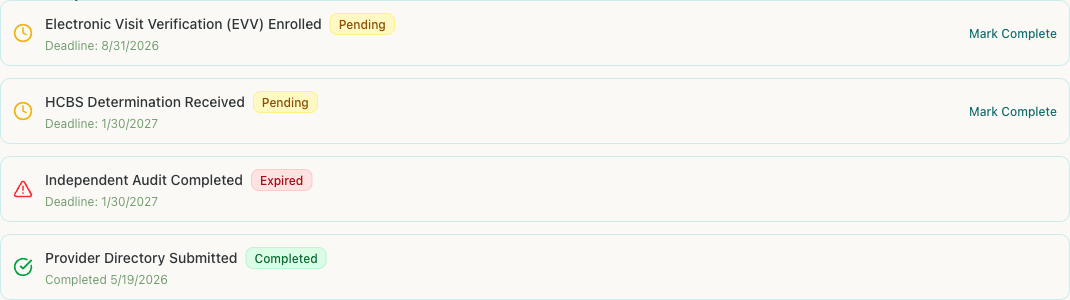
Harbor RC reported 14 providers still outstanding on a past year's audits — because nothing was reminding them of a deadline that isn't the same date for everyone.
Who's exempt — likely the most useful takeaway here
If your regional-center revenue for the state fiscal year is under $500,000, no independent audit or review is required at all. A single 4-6 bed home frequently falls under that floor once you isolate RC-paid revenue from any private-pay or other funding. That means a real share of small residential providers can clear this eligibility item with a phone call to their regional center to confirm exemption status — not a CPA engagement.
What this means for a 4-bed home: before you budget for a CPA, find out whether you need one. Ask your regional center for your organization's RC-revenue figure for the year and whether you're formally recognized as exempt — get that confirmation in writing if you can, the same way you'd want a written exemption on file for EVV. "We're probably under the threshold" is not the same thing as "we're confirmed exempt," and only the confirmed version protects your QIP eligibility if the question ever comes up.
Two situations where you should double-check rather than assume exemption: operating more than one home under a shared vendor number (revenue may aggregate across facilities), and any year where your RC-paid census or rates rose enough that you might have crossed $500,000 without noticing.
Frequently asked questions
How do I know whether I'm over the $500,000 or $2,000,000 threshold?
The thresholds are measured by your total regional-center revenue in a state fiscal year — payments through Purchase of Service authorizations — not your facility's total revenue from every source. A home with meaningful private-pay income could still fall under $500,000 in RC revenue specifically. Ask your regional center's vendoring or fiscal unit for your RC-revenue figure rather than estimating from your full P&L.
Is the independent audit or review due on a fixed date, like December 31 or the end of the state fiscal year?
No — this is the single most common misunderstanding of this requirement. The deadline is 9 months after your own provider's fiscal-year end, not the state's June 30 fiscal year and not a fixed calendar date. A June 30 fiscal-year-end means a March 31 deadline; a December 31 fiscal-year-end means a September 30 deadline. Confirm your own entity's fiscal-year end before you calendar this.
What's the actual difference between an independent audit and an independent review?
Both are performed by a CPA independent of your organization, but an audit is more rigorous — the CPA tests underlying transactions and issues an opinion on your financial statements. A review is more limited — analytical procedures and inquiry, with limited assurance rather than an opinion. These are general accounting-engagement terms, not QIP-specific rules; confirm with your CPA and your regional center which one applies to you.
Can a 4-6 bed home be exempt from the audit/review requirement entirely?
Often, yes. Under $500,000 in regional-center revenue for the state fiscal year, no audit or review is required. A single small residential home frequently falls under that floor. Still, confirm your actual RC-revenue figure and exemption status with your regional center rather than assuming — especially if you run more than one home under a shared vendor number.
What happens if my audit or review is late, or my regional center flags findings I haven't addressed?
Either one blocks your QIP eligibility gate, regardless of how well your reporting measures went. Being behind on a required audit or review — or unresponsive to a regional center's prior findings — keeps this gate red. A written exemption is the only thing that removes the requirement itself; a late filing does not.
If I run more than one home, does the revenue threshold apply per facility or across my whole organization?
Confirm this directly with your regional center rather than assuming. How regional-center revenue is aggregated across multiple facilities under common ownership or a shared vendor number can affect whether you land above or below the $500,000 and $2,000,000 thresholds. Don't extrapolate your exemption status from a single home's numbers if you operate more than one.
Revenue thresholds, deadlines, and exemption determinations are set by statute and applied by your regional center on a case-by-case basis. Always confirm your specific tier, deadline, and exemption status with your regional center and, for the engagement itself, with a CPA — and see the official DDS QIP website for program-level information.