What this means for a 4-bed home: two providers can both hear "QIP" in the same regional center meeting and walk away with completely different obligations and payoffs — one earning up to 10% of an ongoing rate, the other earning a flat $1,000 per resident, one time. The service code on your vendorization paperwork is what decides which one is you.
Why your service code changes the QIP conversation
Our QIP Four-Gate Guide covers what it takes to earn the 10% quality incentive — but that 10%-of-rate structure only applies to homes vendored under specific rate-reform service codes. A different group of codes sits outside rate reform entirely and earns a flat, one-time payment instead. Knowing which group you're in changes what "earning QIP" even means for your home.
Rate-component codes: up to 10% of an ongoing rate
Per Table 1 of D-2025-QIP-017REV, these residential service codes are under rate reform and can earn the quality incentive rate component — split 5% Prevention & Wellness + 5% Provider Capacity, covered gate-by-gate in the Four-Gate Guide:
| Code | Provider type |
|---|---|
| 904 | Family Home Agency (FHA) |
| 905 | Residential Facility Serving Adults — owner-operated |
| 915 | Residential Facility Serving Adults — staff-operated |
| 910 | Residential Facility Serving Children — owner-operated |
| 920 | Residential Facility Serving Children — staff-operated |
| 113 | Specialized Residential Facility (ARFPSHN — Adult Residential Facility for Persons with Special Health Care Needs) |
| — | RCFE, when vendored under 113/905/915 rather than 096/114 |
What this means for a 4-bed home: if you're 905, 915, 910, 920, or 113, the full picture is the Four-Gate Guide — Provider Directory, EVV, Prevention & Wellness, and Provider Capacity — because your rate literally has a 90%-base / 10%-incentive structure built in.
One-time-payment codes: a flat amount, not a rate component
These residential codes are not under rate reform. They don't have a 90/10 rate split — instead, for the FY 2026-27 cycle, they earned a flat $1,000 per resident reported under the Prevention & Wellness measure only:
| Code | Provider type | FY 2026-27 incentive |
|---|---|---|
| 096 114 | Residential Care Facility for the Elderly (RCFE) | $1,000 per resident reported |
| 900 901 | Enhanced Behavioral Support Home (EBSH) | $1,000 per resident reported |
| 163 | Group Home for Children with Special Health Care Needs (GHCSHN) | $1,000 per resident reported |
What this means for a 4-bed home: if you're vendored under one of these codes, don't apply the Four-Gate Guide's "5% + 5% of my rate" math to yourself — you're earning a flat, per-resident, one-time payment, not a percentage of an ongoing rate. The underlying Prevention & Wellness data you gather is similar, but the payoff and the stakes of missing it are structured completely differently.
The full list of roughly 60 QIP-eligible service codes — residential and non-residential — is Attachment A of D-2026-QIP-003. If your code isn't listed above, check that attachment or ask your regional center directly.
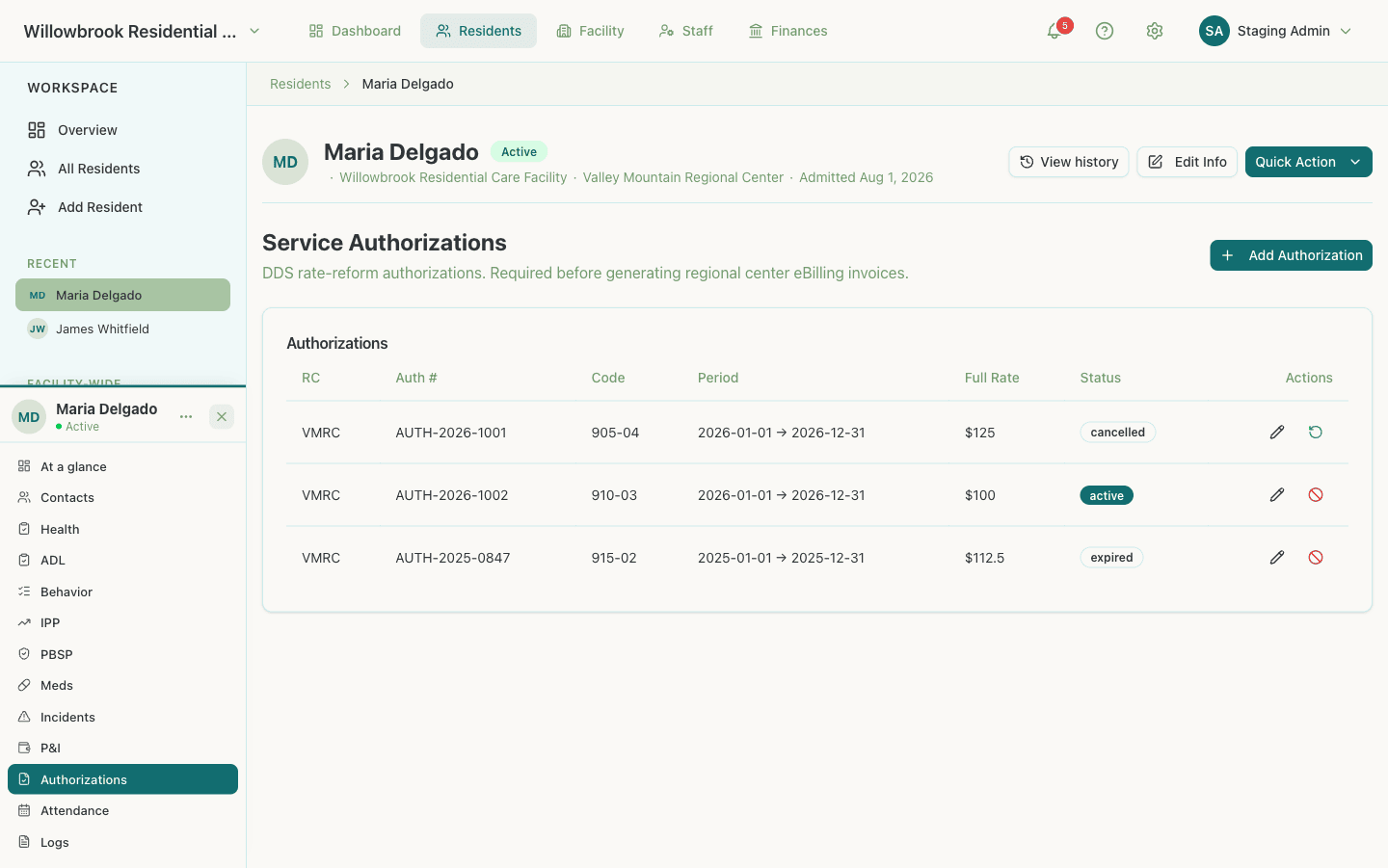
Your service code, already on the authorization
Every resident's Purchase of Service authorization already carries the service code that determines your QIP path. Kura surfaces it alongside the rate and period, so there's no digging through paperwork to answer "which one am I."
Owner-operated vs. staff-operated — does it change your QIP obligations?
Within the residential rate-component codes, DDS distinguishes owner-operated homes (905, 910) from staff-operated homes (915, 920). In practice, this is about who delivers the direct care day to day: an owner-operated home is one where the licensee is substantially the direct-care provider; a staff-operated home is one where the licensee employs non-owner staff to deliver care. This distinction is set on your vendorization paperwork — if you're not certain which applies to you, your regional center's vendoring unit can confirm it.
What this means for a 4-bed home: for QIP specifically, owner- vs. staff-operated status doesn't change your gates or your measures — a 905 and a 915 clear the same four gates and report the same adult Prevention & Wellness measure set for the same possible 5% + 5%. The distinction matters for your rate model generally, not for which QIP rules apply to you.
Frequently asked questions
What's the actual difference between service code 905 and 915?
Both are Residential Facility Serving Adults and both earn the same QIP rate component. 905 is owner-operated (the licensee is substantially the direct-care provider); 915 is staff-operated (the licensee employs non-owner staff). For QIP, the gates and the 5%/5% split are identical either way — confirm which code is on your vendorization paperwork if unsure.
Does 910 vs 920 change anything about the QIP Prevention and Wellness measure?
No. Both report the same children's measure set — annual wellness visit, twice-yearly dental, vision, immunizations. Owner- vs. staff-operated affects rate-model classification generally, not which QIP measures apply.
I hold service code 096 or 114 (RCFE) — do I get the same 10% QIP rate component as a 905 or 910 home?
No. 096/114 aren't under rate reform, so there's no 5%/5% rate component. For the FY 2026-27 cycle, RCFE providers earned a flat one-time $1,000 per resident reported under Prevention & Wellness instead.
Is an Enhanced Behavioral Support Home (900/901) treated like a residential rate-reform provider for QIP?
No. EBSH codes 900/901 sit outside rate reform, like RCFE and GHCSHN, and are eligible only for the one-time $1,000-per-resident incentive, not the 5%/5% rate-component structure.
What service code is a Specialized Residential Facility for adults with special health care needs?
Code 113 — commonly an ARFPSHN. It's under rate reform and earns the same 5% + 5% structure as 905/915/910/920. An RCFE vendored under 113 (rather than 096/114) is treated as a rate-reform provider for QIP.
Where do I find which service code my home is vendored under?
Check your vendorization paperwork (DS 1890/1891) and your residents' Purchase of Service authorizations. Your regional center's vendoring or resource development unit can confirm it, and it should also show on your DDS Provider Directory listing once registered.
Service codes, incentive amounts, and eligibility rules change each fiscal year. Always confirm your current vendored code and its QIP treatment with your regional center and the official DDS QIP website.