What this means for a 4-bed home: "we don't do EVV visits" is not the same answer as "we're clear on the QIP EVV gate." The gate checks whether your registration or exemption status is resolved and on file with your regional center — a question you have to actually ask and get answered, not one that resolves itself because your service type seems obviously exempt.
The real gate: status, not capture
Per DDS directive D-2025-QIP-015 (October 9, 2025), the QIP eligibility gate for Electronic Visit Verification is this: you must either be self-registered for EVV or hold a regional-center-confirmed exemption. That's the whole test. It is not a test of whether your home is actively capturing visit data day to day — it's a test of whether your status with EVV has been resolved and documented, one way or the other, with your regional center. Many small residential settings are capture-exempt, meaning they don't need to capture visit data at all — but capture-exempt is a status that still has to be confirmed, not a fact that excuses you from the gate.
This is the deep-dive companion to Gate 2 of our QIP Four-Gate Guide, and it's written to agree exactly with the EVV section of our QIP Compliance Guide — read either one and you'll get the same mechanics.
What this means for a 4-bed home: the question to ask your regional center isn't "does EVV apply to us?" — it's "is our EVV registration or exemption status confirmed and on file for this cycle?" Those are different questions, and only the second one clears the gate.
Exempt from capture vs. required to register or capture
Where EVV capture does apply, it must record five things about each visit: who provided the service, what service was provided, when it started and ended, where it took place, and whom it was provided to. That five-part model — the "who/what/when/where/whom" of a discrete, in-home visit — is built around personal-care and home-health services delivered as individual visits, which is why it maps awkwardly onto a 4-6 bed home providing continuous, 24-hour congregate residential care rather than scheduled visits. That structural mismatch is generally why many small residential settings end up capture-exempt.
| Setting / situation | Typical pattern | What actually clears the gate |
|---|---|---|
| 4-6 bed ARF or group home (905/915/910/920) providing continuous residential care | Often capture-exempt | Exemption confirmed and on file with your regional center — not assumed |
| Provider also delivering discrete in-home personal-care or home-health visits under a separate vendorization | May need to register and capture | Registration completed for those specific services; confirm scope with your regional center |
| Newly vendored, re-vendored, or reactivated home | Status not yet resolved | Resolve EVV status on the initial on-ramp clock (D-2026-QIP-001), don't wait for a survey |
| Home that has never discussed EVV with its regional center | Status unresolved by default | No exemption exists until your RC affirmatively confirms one — ask now |
What this means for a 4-bed home: don't self-diagnose your exemption from the shape of your program. Ask your regional center to confirm it in writing, and keep that confirmation with your other QIP eligibility evidence — the same way you'd keep an audit exemption letter or an HCBS determination letter.
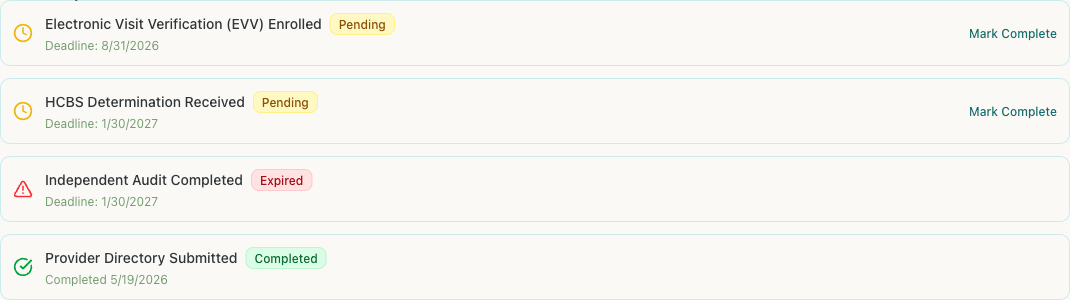
EVV status, feeding your overall QIP picture
Whichever way your status resolves — registered, exempt, or still pending — it shouldn't be something you have to reconstruct from memory when a regional center rep asks.
Why this is the single biggest point of confusion in RC minutes
Regional-center advisory-committee minutes reviewed across the state in 2026 point to EVV status as the single most recurring point of confusion in QIP discussions — one regional center's minutes reportedly noted a batch of roughly 22 vendors still unenrolled close to a deadline. The pattern behind that kind of number is almost always the same: an administrator reasonably concludes "EVV doesn't apply to us, we don't do home-visit personal care" and stops there, without ever getting that conclusion confirmed as an exemption with their regional center. Under D-2025-QIP-015, that unconfirmed status is exactly what withholds the incentive — even if every survey was reported completely and accurately.
What this means for a 4-bed home: if you cannot point to a specific conversation, email, or letter in which your regional center confirmed your EVV status this cycle, treat that as an open item today — not a settled question you can answer from general knowledge of your program type.
What's changing — and what isn't, yet
For the current reporting cycle, registration or a confirmed exemption is sufficient to clear the EVV gate — a good-faith registration effort counts, and a confirmed exemption counts. Nothing about actual day-to-day visit capture is being scored today for homes that are exempt from capture.
That is set to change. D-2026-QIP-001 states that "actual implementation" of EVV — not just registration or a good-faith effort — will be required in future fiscal years, in settings where EVV applies. This is a future change, not a current requirement: as of this update, DDS has not published which fiscal year the shift takes effect, nor the operational detail of what "actual implementation" will mean for a home that is currently capture-exempt. We'll update this guide, our QIP Dateline, and our EVV Compliance Guide's EVV section the same week DDS publishes that detail.
What this means for a 4-bed home: don't let "actual implementation" become next cycle's version of "we thought EVV didn't apply to us." Get your exemption or registration confirmed now, and watch for the directive that sets the effective date — it will likely apply only to settings where EVV capture already applies, not to every capture-exempt home by default, but that has not been confirmed yet either way.
Key EVV dates for QIP, published vs. projected
Dates marked Future / Not Yet Set are a confirmed direction from DDS with no effective date published yet — not a projection based on pattern-matching. For the complete, continuously updated QIP timeline, see the QIP Dateline →
| Date | What | Status | Directive |
|---|---|---|---|
| Oct 9, 2025 | EVV eligibility gate directive issued (registration or confirmed exemption required) | Published | D-2025-QIP-015 |
| Feb 27, 2026 | Extended deadline for all eligibility gates, including EVV, for FY 2026-27 (originally Jan 31) | Published | DDS extension, Jan 12, 2026 |
| Not yet set | "Actual implementation" of EVV (not just registration) becomes required, in settings where EVV applies | Future / Not Yet Set | D-2026-QIP-001 |
Newly vendored, re-vendored, or reactivated providers resolve EVV status on a separate rolling clock rather than the annual cycle deadline — see the on-ramp section of the Four-Gate Guide's dates section for the mechanics.
Frequently asked questions
Is my 4-6 bed group home exempt from EVV visit capture?
Many small residential settings are — EVV's federal design targets discrete, in-home personal-care and home-health visits, not 24-hour congregate residential care. But "often exempt" isn't "automatically exempt": the QIP gate requires that exemption be confirmed with your regional center, not merely assumed. Confirm your specific status directly rather than treating your service type as a self-executing exemption.
What counts as a regional-center-confirmed EVV exemption?
Your regional center affirmatively recording that your home doesn't need to capture EVV visit data — not simply never having been asked about it. If you've never had that conversation, you don't have a confirmed exemption yet, even if your service type seems like an obvious fit. Ask for written confirmation and keep it on file.
What happens if my home was never registered for EVV and has no exemption on file?
Per D-2025-QIP-015, an unresolved EVV status can withhold your quality incentive rate component even if your surveys were reported completely and accurately — the exact scenario behind reports of regional centers finding vendors unenrolled close to a deadline. Contact your regional center now to register or get an exemption confirmed.
Will EVV registration alone still be enough for QIP after the current cycle?
For now, yes. But D-2026-QIP-001 states "actual implementation" will be required in future fiscal years, in settings where EVV applies. DDS hasn't yet set the effective fiscal year or the operational detail — treat this as a confirmed future direction, not a current requirement, and watch for the directive that sets the date.
Does the EVV gate work differently for a newly vendored group home?
The gate itself is the same — registration or a confirmed exemption — but newly vendored, re-vendored, or reactivated providers resolve it on a separate rolling clock under D-2026-QIP-001 rather than the annual cycle deadline. Resolve it as part of initial vendorization paperwork, not after a survey prompts it.
Where do I actually register for EVV or ask about an exemption?
Start at the DDS EVV page (dds.ca.gov/services/evv) for self-registration, and raise exemption questions directly with your regional center's vendoring or program contact — they confirm exemption status for QIP purposes. Resolve it proactively; don't wait for a QIP survey email to surface it.
EVV rules, exemption practices, and implementation timelines can change each fiscal year, and the effective date for "actual implementation" was not yet published as of this update. Always confirm current requirements with your regional center and the official DDS EVV page.