What this means for a 4-bed home: HCBS Settings Rule compliance isn't a form you file once — it's the daily texture of the home: who chose the roommate pairing, whether a resident can have a visitor at 7pm on a Tuesday, whether the plan on file actually reflects what the resident wants. Get it right and it's invisible. Get it wrong and, starting July 9, 2026, a resident or family member has a federal grievance right to say so — on top of it already being one of the things that can quietly block your QIP 10%.
What the HCBS Settings Rule actually is
The Home and Community-Based Services (HCBS) Settings Final Rule is a federal Medicaid regulation (42 CFR §441.301(c)(4)-(5)) that sets requirements for any setting where people receive Medicaid-funded home and community-based services — including licensed residential facilities like ARFs. In broad strokes, it requires that a setting be integrated in and support full access to the greater community; be selected by the individual from among setting options; ensure individual rights of privacy, dignity, respect, and freedom from coercion; optimize individual initiative, autonomy, and independence in making life choices; and facilitate individual choice regarding services and supports and who provides them.
This is a distinct regulation from California's DDS Quality Incentive Program — QIP is a rate-reform incentive, HCBS is a decades-old federal Medicaid settings requirement — but the two are connected. For the fuller picture of how HCBS fits alongside QIP's other requirements, see our QIP Compliance Guide and the pillar guide this page is a deep-dive companion to, The QIP Four-Gate Guide.
Why HCBS compliance is one of the things that can quietly block your 10%
Per DDS's January 8, 2024 directive, your vendoring regional center — not DDS directly — determines whether your home is compliant with the HCBS Settings Rule, and that determination is one of QIP's underlying eligibility gates. DDS stated that as of July 2025 all service providers had been determined compliant. That's good news, but it describes a point in time: the Four-Gate Guide frames HCBS alongside the independent audit/review requirement as one of two things that can quietly block your 10% anyway, sitting underneath the four gates most homes actively manage day to day.
What this means for a 4-bed home: you likely already hold an HCBS compliance determination from your regional center. The open question isn't "did we pass once" — it's "are our everyday practices still what that determination said they were." That's what the rest of this guide covers.
Person-centered planning
The HCBS Settings Rule requires that services and supports be delivered through a person-centered planning process, built around the individual's own goals and preferences rather than a template. In a licensed California residential facility, the closest paperwork analog is the LIC 625 needs and services plan, which Title 22 already requires you to update at least annually — but a plan can satisfy the licensing requirement and still fail the person-centered one if it was written about the resident instead of with them.
What this means for a 4-bed home: when you sit down to update a resident's LIC 625, the conversation should be visibly theirs — their stated goals, their preferences about daily routine, documented in language that traces back to something the resident (or their representative) actually said, not boilerplate carried over from last year's file.
Resident rights and choice: the "lease-like protections"
This is the part of the rule most often described as "lease-like protections," because it asks a licensed facility to preserve the kinds of rights a person would have in their own home or apartment, even though a group home isn't literally a rental. In practice, that covers:
Choice of roommate
Roommate pairings should reflect the residents' own preferences and compatibility, not just bed availability or staff convenience. Document how a pairing was decided and revisit it if a resident asks.
Choice of daily schedule
Wake times, mealtimes, and activities should follow the resident's own preferences within the bounds of safety and staffing, not a single house-wide schedule applied uniformly to everyone regardless of what they'd choose for themselves.
Visitors at times of the resident's choosing
Residents generally have the right to visitors they choose, at times they choose, the same as anyone would in their own home. A blanket house rule restricting visiting hours for everyone reads as exactly the kind of institutional practice this rule is designed to catch — any restriction needs to be individualized to a specific resident's documented needs, not a standing policy.
Privacy and personal possessions
Residents should have privacy in their sleeping and living space (including a lockable door where feasible), access to their own possessions, and control over their own food and belongings, consistent with the "own home" standard the rule is built around.
What this means for a 4-bed home: the fastest way to self-check this section is to ask, for any house rule you enforce uniformly, "would this rule exist if this were the resident's own apartment?" A rule that only exists because it's easier to run the facility that way is the kind of thing an HCBS reviewer — or, after July 9, 2026, a resident's own grievance — is most likely to flag.
The physical setting: integrated in the community
The rule also reaches the physical setting itself: it must be integrated in and support access to the greater community, including opportunities to seek employment, engage in community life, control personal resources, and receive services in the community to the same degree as individuals not receiving Medicaid HCBS. Settings that isolate residents from the broader community — physically or through restrictive scheduling — don't meet the standard, regardless of how well the paperwork reads.
What this means for a 4-bed home: community access isn't satisfied by having an address in a residential neighborhood — it's satisfied by residents actually getting out into that community on a schedule that reflects their own interests, which is worth tracking the same way you track drills or postings, not just assuming happens.
The July 9, 2026 federal grievance right
The federal Medicaid Access Rule gives individuals a grievance right for alleged HCBS noncompliance after July 9, 2026. Practically, that means a resident, family member, or advocate now has a defined federal path to raise a concern that a home's day-to-day practices don't match HCBS Settings Rule requirements — separate from, and in addition to, your regional center's own compliance determination and CCLD's licensing oversight.
What this means for a 4-bed home: this doesn't create a new form for you to file — it creates a new way for someone else to raise one about you. The practical response is the same as everything else in this guide: make sure the everyday practice (roommate choice, visiting hours, the person-centered plan) actually matches what your paperwork says it is, before July 9, 2026 gives a resident a formal reason to check.
Staying compliant day to day
HCBS compliance sits alongside the rest of your inspection readiness — required postings, drills, and the practices above all get checked the same way, on the same kind of visit. Regional centers keep monitoring through their existing visit schedule (quarterly consumer meetings, at least one facility liaison QA visit a year, and at least two unannounced visits a year under WIC §4648.1), which is the same cadence that surfaces HCBS gaps in practice, not just on paper.
Everyday practice, tracked the same way as everything else
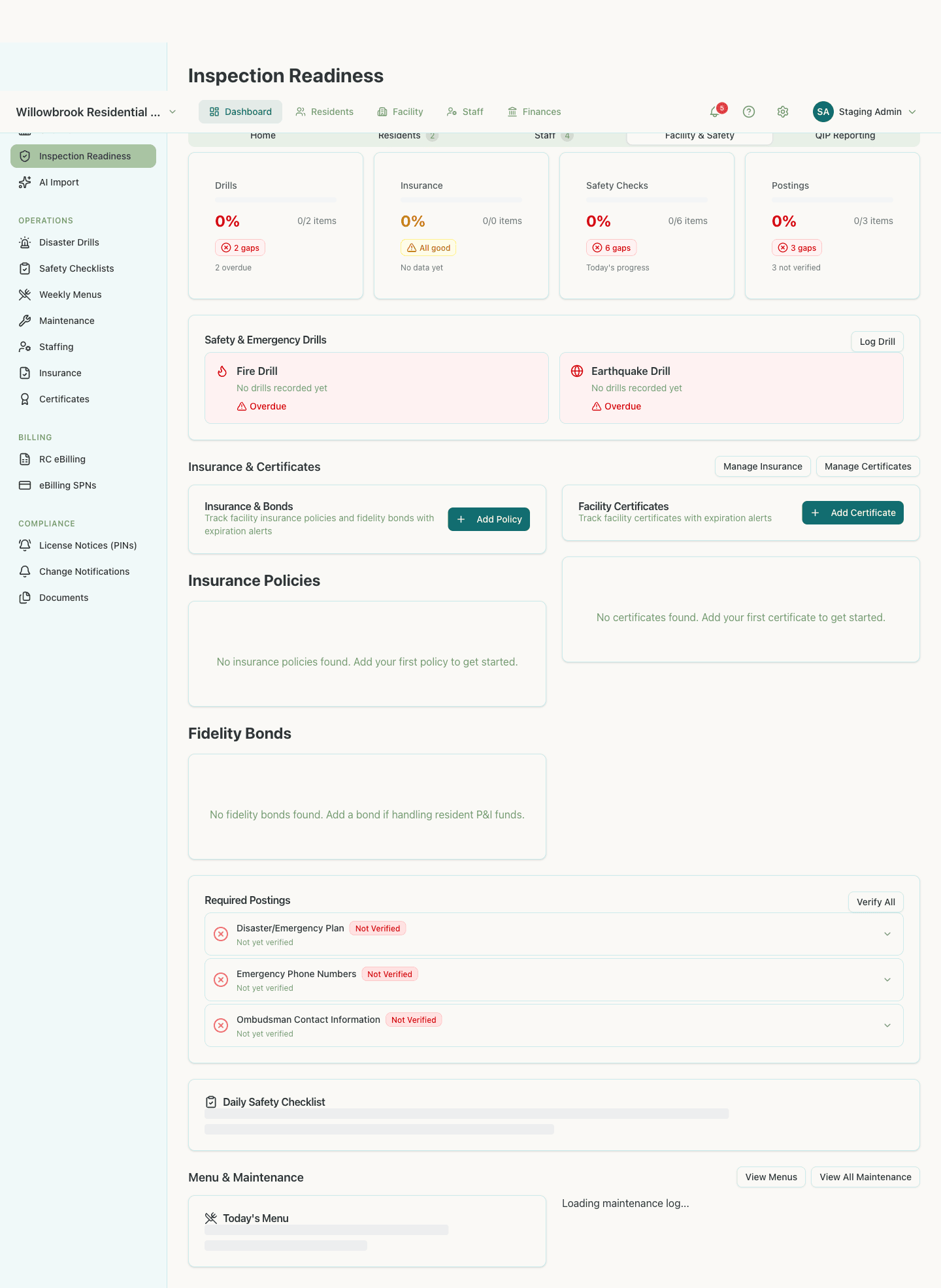
Kura's Inspection Readiness view is where the facility-side half of HCBS readiness — postings, drills, documentation that has to match practice — lives day to day.
Key dates, published vs. projected
Every date below cites the directive or rule that set it. For the complete, continuously updated QIP timeline this fits inside — including whatever DDS publishes next — see the QIP Dateline →
| Date | What | Status | Source |
|---|---|---|---|
| Jan 8, 2024 | DDS directive establishing how regional centers determine HCBS Settings Rule compliance | Published | DDS HCBS directive, Jan 8, 2024 |
| Jul 2025 | DDS reports all service providers determined compliant under the Jan 8, 2024 directive | Published | DDS QIP program records |
| Jul 9, 2026 | Federal Medicaid Access Rule grievance right for alleged HCBS noncompliance takes effect | Published | Federal Medicaid Access Rule |
HCBS compliance is also one of the four eligibility gates under the DDS Quality Incentive Program — see the Four-Gate Guide's full QIP timeline for the surrounding survey and eligibility deadlines this sits alongside.
Frequently asked questions
Is the HCBS Final Rule the same thing as QIP?
No. QIP is a DDS rate-reform incentive program; the HCBS Settings Final Rule is a separate federal Medicaid regulation about how home and community-based settings must operate. They intersect because HCBS compliance, as determined by your regional center, is one of QIP's underlying eligibility gates.
Do I need to do anything new for the July 9, 2026 grievance right?
The grievance right doesn't require a new form or filing from your home — it gives residents and families a defined federal path to raise alleged HCBS noncompliance. Treat it as a reason to re-check that your everyday practices match your paperwork now, not as a new task with its own deadline.
Was our HCBS compliance a one-time approval, or do we need to keep proving it?
DDS reported all providers determined compliant as of July 2025, but that describes a point in time. Regional centers keep monitoring through their existing visit schedule, and the July 9, 2026 grievance right puts the same everyday practices under a brighter light. Compliance is something you maintain, not something you finish.
What's the difference between a person-centered plan and the LIC 625 needs and services plan?
The LIC 625 is the Title 22 licensing document, updated at least annually. Person-centeredness under HCBS is a broader requirement that the plan and the daily practices around it actually reflect the resident's own goals and preferences — not a template filled in on their behalf.
Can a group home restrict when residents have visitors?
Generally, residents have the right to visitors of their choosing at times of their choosing, the same as in their own home. A blanket house-wide visiting-hours rule is the kind of institutional practice the rule is designed to catch; individualized, documented exceptions for a specific resident's needs are a different matter.
HCBS Settings Rule compliance determinations are made by your regional center, and federal Medicaid rules can change. Always confirm your current status with your regional center and the DDS HCBS regulations page.